Labalábá
The stories of my parents and my own life will have to be uncovered in ways that cannot be neatly measured. I am a vagabond by profession—a travel nurse moving from state to state—and as useful as the phone is for communication, it is not how I want to learn about the stories that created me and my four siblings. For those stories, I will wait for the increasingly rare family gatherings when we can all sit in a circle and remember together.
June 20th, 2026. St. Petersburg, FL.
What I think I know is no longer enough.
I have reached a point in my life where I need more information about my past.
One could say I am in a phase of choosing to study. This phase started years ago, but not with the vigor I feel right now. My choice to pursue photography felt like the first real decision of my life. Before that, most decisions were either made for me or made out of necessity.
That was in 2016, ten years ago.
The next decision that felt like my own was studying music by way of the saxophone. That was in 2023, three years ago. I’m far from great, but I trust I’ll get there. I’m kind of obsessed with that horn. Craftsmanship followed. In January, I began studying ceramics. Now I can make a mug, a plate, and a few other things.
Yet what leaves me most discontent is how little I know about the things that made me who I am: my mother, my father, my country, and myself.
The stories of my parents and my own life will have to be uncovered in ways that cannot be neatly measured. I am a vagabond by profession—a travel nurse moving from state to state—and as useful as the phone is for communication, it is not how I want to learn about the stories that created me and my four siblings. For those stories, I will wait for the increasingly rare family gatherings when we can all sit in a circle and remember together.
I am writing this while in Florida, in one of those settings. It is the first time since 2017 that my entire family has been together for an extended period of time. While I piece together my family history through the words of my parents, the rest—my culture, my heritage—can be learned through books.
I want to know more about the Yoruba people of Nigeria. What art did they create? What music did they sing? How did they arrive at their ways of expression? What compelled them to make anything at all?
I have already begun my search. In this respect, I started with divinity—with the myths, the stories of creation, the Orishas, and the ways the Yoruba understood the world before colonialism and Christianity reshaped so much of everyday life. It feels like a good place to start.
I came to the United States in 2014 at seventeen years old. Before then, I hated school. More specifically, I hated Yoruba. I refused to learn it.
Part of it was pride. I had convinced myself that those who spoke only Yoruba were poor, uneducated, somehow lesser than those of us learning English. They were farmers. They were not privileged enough to attend the schools I attended.
Years later, I am ashamed of that thinking. With much-needed accountability, I have learned just how lazy I was. My great-grand-aunt, known by me as “Grandma,” the woman who saved my life and my family’s life, spoke Yoruba fluently. Was she poor? Uneducated? A farmer? On the contrary, she remains the most successful and educated woman I know. RIP.
I remember having a conversation with a friend in London. She used a Yoruba word in conversation—labalábá—and asked if I knew what it meant.
“Yeah,” I replied, hoping the conversation would move on before my ignorance became obvious.
Instead, she paused and asked me to define it.
The shame settled deep inside me as a woman far removed from my culture taught me, a man born and raised in Lagos, the Yoruba word for my favorite insect: the butterfly.
Now I find myself wanting to dive into the very thing I once rejected.
Ever since arriving in America, I have felt a sense of disconnection—an inability to fully fit in with friends, communities, or even myself. Imagine living with imposter syndrome as a lifestyle.
When I moved to Cleveland, Ohio, I found myself distancing from the Nigerian community there. It never felt as though I was fully accepted. Much of my experience of the Nigerian community was filtered through Christianity and the social circles surrounding my father—a man I barely knew.
The judgment I encountered over small things, things that seemed inconsequential, pushed me away from the religion. Eventually, my rejection of Christianity became tangled up with a rejection of Yoruba culture itself. I walked away from both.
I still had Nigerian friends. We spent time together, laughed together, lived experiences together. But culture became something increasingly distant.
Then I moved to Allentown, Pennsylvania, where there was no familiar culture at all. It was just me and my brother.
Then Philadelphia. Just me.
Then New York.
By then, I had become a kind of cultural and religious nomad, loving the solitude such a lifestyle brought.
In New York, I set out to discover who I was through art. I had no blood family nearby. My relationships did little to reconnect me to my roots. Nigeria, Yoruba culture, and everything attached to them faded into the background of my life.
Then there were moments that pushed me even further away.
I met a Yoruba woman with whom I wanted to collaborate. After hearing my full name, she spoke to me in Yoruba. I understood her. I responded in English.
She asked why I didn’t answer in our language, and I told her the truth: I can understand conversational Yoruba almost fluently, but I cannot speak it.
Immediately, I felt judged. Whether that judgment was real or imagined no longer matters. What matters is that it reinforced the distance I already felt.
After years of feeling removed from my culture, I have reached an understanding: culture is not something that can be handed back to me by a community, a religion, or another person. It is something I must actively pursue. Something I must choose to define for myself.
I don’t know exactly what I will find. Perhaps answers. Perhaps more questions.
What I do know is that somewhere between Lagos and America, between Christianity and my rejection of it, between English and the Yoruba I refused to learn, pieces of myself were left unexplored.
This publication will serve as a digital journal of my attempt to find them. A place for notes, research, memories, and questions as I learn more about my family, Yoruba culture, language, art, and where I come from.
I have begun with family, art, history, and divinity as pathways back to a language and culture I once rejected.
I will follow the threads wherever they lead, documenting what I learn along the way in the hope that these scattered pieces eventually form a picture I recognize.
Vagabond Archives
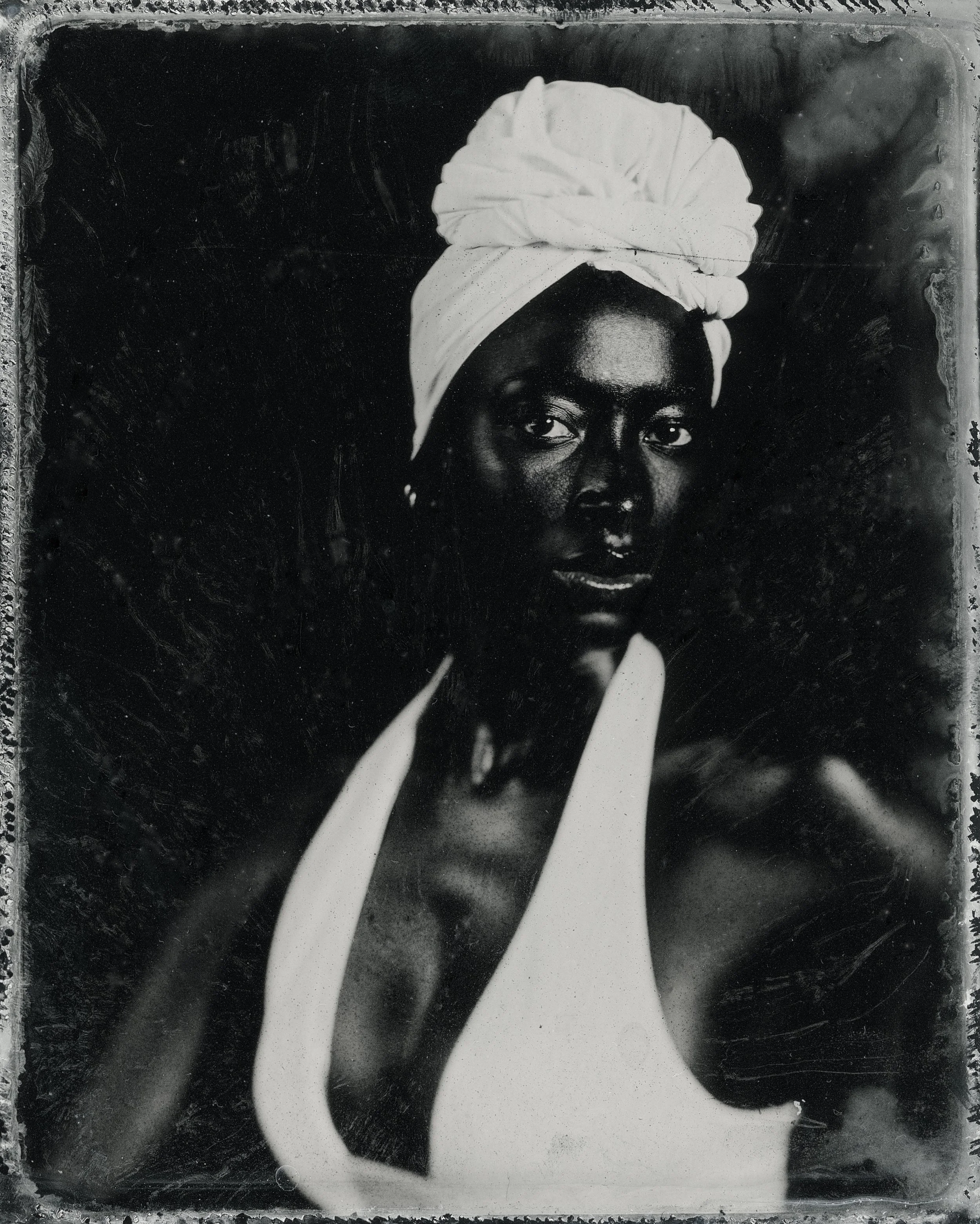
Working with the nineteenth-century wet plate collodion process, every tintype is handmade, one of one, and designed to endure for generations.
Preserving Memory Through Tintype
Vagabond Archives is a traveling tintype portrait studio and living archive documenting culture, identity, migration, and belonging through the historic wet plate collodion process.
Created by Nigerian artist and tintype photographer Oluwatosin Popoola, the project travels between cities to create museum-quality tintype portraits while collecting the stories that accompany them. Participants are invited to wear traditional clothing or bring meaningful objects that speak to their history, allowing each portrait to become both an image and a record of memory.
Working with the nineteenth-century wet plate collodion process, every tintype is handmade, one of one, and designed to endure for generations. These archival portraits become heirlooms that resist the impermanence of today’s digital images.
Whether photographed in Los Angeles, New York, Cleveland, or future cities across the African diaspora, every portrait contributes to an expanding visual archive exploring heritage, family, migration, and home.